This post is essentially a continuation of the earlier post, Abraham the Astronomer (Part 1), so if you haven’t read that one yet, it’s recommended as the ‘prologue’ to this one. In that post, we saw that there are many rabbinic sources that associate Abraham with astronomy and characterize him as an ancient astronomer. But were the talmudic rabbis the earliest Jews to characterize Abraham this way?
In the centuries before the Talmudic rabbis, there were numerous other ancient Jewish writers who also connected Abraham to astronomy, with various different understandings of the nature of the connection.
Jubilees, a text from roughly the second century BCE makes Abraham’s rejection of astrology (based on his own thinking and observations) the kickoff of his story as told in the Torah. In this retelling, first Abraham rejected astrology, then God speaks to him and gives him the command to go to the Land of Canaan as found in Genesis 12:1.
Jubilees, Ch. 12: 15-22
And Terah went forth from Ur of the Chaldees, he and his sons, to go into the land of Lebanon and into the land of Canaan, and he dwelt in the land of Haran, and Abram dwelt with Terah his father in Haran two weeks of years. [=14 years]
And in the sixth week, in the fifth year thereof, [1951 A.M.] Abram sat up throughout the night on the new moon of the seventh month to observe the stars from the evening to the morning, in order to see what would be the character of the year with regard to the rains, and he was alone as he sat and observed.
And a word came into his heart and he said: All the signs of the stars, and the signs of the moon and of the sun are all in the hand of the Lord. Why do I search (them) out?
If He desires, He causes it to rain, morning and evening; And if He desires, He withholds it, And all things are in his hand.’
And he prayed that night and said, ‘My God, God Most High, Thou alone art my God, And Thee and Thy dominion have I chosen. And Thou hast created all things, And all things that are the work of thy hands.
…
And he made an end of speaking and praying, and behold the word of the Lord was sent to him through me, saying: ‘Get thee up from thy country, and from thy kindred and from the house of thy father unto a land which I will show thee, and I shall make thee a great and numerous nation.’
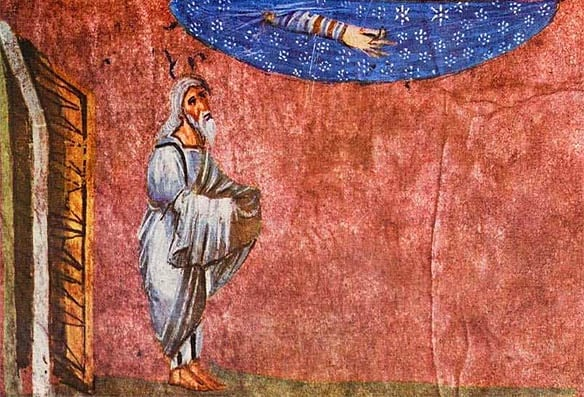
The Jubilees storyline is similar to rabbinic midrashim that also say that Abraham “recognized his Creator” based on his own thinking before God revealed Himself to him. (Although this is not the beginning of that recognition in Jubilees; Abraham’s story is already in progress when this episode happens.) It is interesting to note that the year indicated 1951 A.M. (=anno mundi, from the Creation of the World) corresponds to the rabbinic tradition that Abraham recognized his Creator at the age of three (in the rabbinic chronology, as well as applying arithmetic to Genesis, Abraham was born in 1948 A.M.) even though in Jubilees’ chronology he is obviously considerably older in this story.
It is also of note that this episode of Abraham’s astronomical observation and subsequent revelation in Jubilees occurs on the night on the new moon of the seventh month – the date that we now call Rosh Hashanah! Abram’s astronomical observations are in order “to see what would be the character of the year with regard to the rains”, but then he decides or realizes that God controls and determines the outcome of the rains for the year – apparently on that selfsame date. This understanding that the World’s upcoming year’s decree being determined on Rosh Hashanah is a concept we are familiar with, but that is not mentioned in the Torah’s descriptions of the holiday on the First of the Seventh month. (see Leviticus 23:24-5, Numbers 29:1-6) One might say that the author(s) of Jubliees retconned Abraham’s origin story into the Rosh Hashanah holiday, effectively providing Rosh Hashanah with a narrative (as some other holidays, like Passover, clearly have in the Torah.) Note that rabbinic tradition, in a similar manner, associates Rosh Hashanah with Issac’s birth and the Akedah stories.
Another early source (most probably dated to the 1st century CE…) is the (so called) Apocalypse of Abraham. “Apocalypse” in this context essentially means “vision” – i.e. a prophetic vision. In this work of unknown authorship, the story of Abraham begins with him realizing the falseness of his father’s idols (much as rabbinic midrashim depict events) then God calls out to him, and after saving him from the destruction of his father Terach’s house, He commands the series of sacrifices in Genesis 15:9 (out of sequence with the Torah, while Abram is still in Mesopotamia, presumably; also note that these sacrifices are preceded by the reference to counting the stars in Genesis 15) Abraham is taken on a journey by angels to Mt. Horeb (similar to Moses and Elijah) and there receives a vision guided by angel(s) that takes him up to the heavens.
Once he is up in the heavens (after roughly 19+ “chapters”) we find a very similar statement to the previously cited rabbinic explanation of Abraham being taken above the “dome of the heavens”:
Apocalypse of Abraham 20:5 (Pseudepigrapha)
1 And the Eternal Mighty One said to me, “Abraham, Abraham!” 2 And I said, “Here am I!” 3 And he said, “Look from on high at the stars which are beneath you and count them for me and tell me their number!” 4 And I said, “Would I be able? For I am [but] a man.” 5 And he said to me, “As the number of the stars and their host, so shall I make your seed into a company of nations, set apart for me in my lot with Azazel.
Here we see the idea we previously saw in Bereshit Rabbah (and Rashi) presented in a much less familiar but historically earlier text. We also find it in another roughly contemporaneous source, referred to as “Pseudo Philo” because… it’s not really written by Philo.
Pseudo Philo Biblical Antiquities 18:5
[Pseudo-Philo is the name commonly used for the unknown, anonymous author of Biblical Antiquities. Date: c. 50-120 C.E…??? ]
4 And in the night God said unto him: Who are the men that are come unto thee? And Balaam said: Wherefore, Lord, dost thou tempt the race of man? They therefore cannot sustain it, for thou knewest more than they, all that was in the world, before thou foundedst it. And now enlighten thy servant if it be right that I go with them. 5 And God said to him: Was it not concerning this people that I spake unto Abraham in a vision saying: Thy seed shall be as the stars of heaven, when I raised him up above the firmament and showed him all the orderings of the stars, and required of him his son for a burnt offering? and he brought him to be laid upon the altar, but I restored him to his father.
The real Philo, who was a first century CE Alexandrian Jewish philosopher, has a somewhat different, less apocalyptic, take on the connection between Abraham and astronomy. He writes that Abraham needed to abandon the astronomy and the ways of the “Chaldeans”, i.e. his native place. Only once he had migrated away both geographically and philosophically from his “Chaldean” origins, did God appear to him:
Philo, On Abraham
XVII. (77) And the most visible proof of this migration in which the mind quitted astronomy and the doctrines of the Chaldaeans, is this. For it is said in the scriptures that the very moment that the wise man quitted his abode, “God appeared unto Abraham,”{10} to whom, therefore, it is plain that he was not visible before, when he was adhering to the studies of the Chaldaeans, and attending to the motions of the stars, not properly comprehending any nature whatever, which was well arranged and appreciable by the intellect only, apart from the world and the essence perceptible by the outward senses. (78) But after he changed his abode and went into another country he learnt of necessity that the world was subject, and not independent; not an absolute ruler, but governed by the great cause of all things who had created it, whom the mind then for the first time looked up and saw; (79) for previously a great mist was shed over it by the objects of the external senses, which she, having dissipated by fervent and vivid doctrines, was scarcely able, as if in clear fine weather, to perceive him who had previously been concealed and invisible. But he, by reason of his love for mankind, did not reject the soul which came to him, but went forward to meet it, and showed to it his own nature as far as it was possible that he who was looking at it could see it. (80) For which reason it is said, not that the wise man saw God but that God appeared to the wise man; for it was impossible for any one to comprehend by his own unassisted power the true living God, unless he himself displayed and revealed himself to him.
Philo further explains that Abram’s name change to Abraham is understood as changing away from the pursuit of astronomy, and to the wisdom of following God:
XVIII. (81) And there is evidence in support of what has here been said to be derived from the change and alteration of his name: for he was anciently called Abram, but afterwards he was named Abraham: the alteration of sound being only that which proceeds from one single letter, alpha, being doubled, but the alteration revealing in effect an important fact and doctrine; (82) for the name Abram being interpreted means “sublime father;” but Abraham signifies, “the elect father of sound.” The first name being expressive of the man who is called an astronomer, and one addicted to the contemplation of the sublime bodies in the sky, and who was versed in the doctrines of the Chaldaeans, and who took care of them as a father might take care of his children. (83) But the last name intimating the really wise man; for the latter name, by the word sound, intimates the uttered speech; and by the word father, the dominant mind. For the speech which is conceived within is naturally the father of that which is uttered, inasmuch as it is older than the latter, and as it also suggests what is to be said. And by the addition of the word elect his goodness is intimated. For the evil disposition is a random and confused one, but that which is elect is good, having been selected from all others by reason of its excellence. (84) Therefore, to him who is addicted to the contemplation of the sublime bodies of the sky there appears to be nothing whatever greater than the world; and therefore he refers the causes of all things that exist to the world. But the wise man, beholding with more accurate eyes that more perfect being that rules and governs all things, and is appreciable only by the intellect, to whom all things are subservient as to the master, and by whom every thing is directed, very often reproaches himself for his former way of life, and if he had lived the existence of a blind man, leaning upon objects perceptible by the outward senses, on things by their very nature worthless and unstable.
Josephus is mostly famous for being the primary source for Jewish history in the later days of the Second Temple period. However, in Antiquities of the Jews, he retells to a large extent the history recorded in the Bible as well, including in his retelling much extra material that we would today characterize as “aggadah.” Regarding Abraham, he also tells us that he was an astronomer, and characterizes this in a very positive light, unlike Philo, or some of the other commentaries we have seen:

Josephus, Ant. 1:7:1-2
He was a person of great sagacity, both for understanding all things, and persuading his hearers, and not mistaken in his opinions. For which reason he began to have higher notions of virtue than others had; and he determined to renew and to change the opinion all men happened then to have concerning God. For he was the first that ventured to publish this notion, that there was but One God, the Creator of the Universe: and that as to other [Gods], if they contributed any thing to the happiness of men, that each of them afforded it only according to his appointment, and not by their own power. This his opinion was derived from the irregular phenomena that were visible both at land and sea; as well as those that happen to the sun, and moon, and all the heavenly bodies, thus: “If [said he] these bodies had power of their own, they would certainly take care of their own regular motions: but since they do not preserve such regularity, they make it plain that in so far as they co-operate to our advantage, they do it not of their own abilities, but as they are subservient to him that commands them: to whom alone we ought justly to offer our honour and thanksgiving.” For which doctrines when the Chaldeans and other people of Mesopotamia raised a tumult against him, he thought fit to leave that country; and at the command, and by the assistance of God, he came and lived in the land of Canaan.
2. Berosus mentions our father Abram without naming him, when he says thus; “In the tenth generation after the flood, there was among the Chaldeans a man, righteous, and great, and skilful in the celestial science.”
Josephus takes the approach that the study of astronomy led to Abraham’s recognizing God as the sole Creator and deity. In particular, he seems to allude to retrograde motion (i.e. “irregular phenomena… they do not preserve such regularity…”) perhaps reminiscent of the allusion to it that we previously saw in the Talmud on b. Shabbat 156b. We’ll see some further insight on that particular point below.
For good measure, Josephus also praises Abraham as the great sage who brought the wisdom of astronomy (and mathematics) to Egypt, in his travels there (described in Genesis 12).
Ibid. 1:8:2
For whereas the Egyptians were formerly addicted to different customs, and despised one anothers sacred and accustomed rites, and were very angry one with another on that account; Abram conferred with each of them, and confuting the reasonings they made use of, every one for their own practices, he demonstrated that such reasonings were vain, and void of truth. Whereupon he was admired by them, in those conferences, as a very wise man, and one of great sagacity, when he discoursed on any subject he undertook; and this not only in understanding it, but in persuading other men also to assent to him. He communicated to them Arithmetick; and delivered to them the science of Astronomy. (28) For before Abram came into Egypt they were unacquainted with those parts of learning: for that science came from the Chaldeans into Egypt; and from thence to the Greeks also.
This also means that he is indirectly the one responsible for the Greeks (and everyone else since!) having knowledge of astronomy and math! Where would science and Western Civilization be without him!?!
A modern scholar, Annette Yoshiko Reed (Magid), has written about this idea in depth in her article “Abraham As Chaldean Scientist And Father Of The Jews: Josephus, “Ant.” 1.154-168, and the Greco-Roman Discourse About Astronomy/Astrology” (Journal for the Study of Judaism in the Persian, Hellenistic, and Roman Period , 2004, Vol. 35, No. 2 (2004), pp. 119-158) In her article she analyzes some of the above sources, but Josephus in particular. She adds a great valuable insight to understand some of the origins of this idea, based on the Torah telling us that Abraham was born in Ur Kasdim, and the association of that locale with astronomy in the ancient world:
The association of Abraham with astronomy/astrology arises frequently in early Jewish literature. Its ultimate derivation likely lies in Genesis’ assertion of the Chaldean birthplace of the patriarch. In Genesis, Abraham’s origins in □אור כשדי (Gen 11.28, 31; 15.7) may be meant as an acknowledgement of the Mesopotamian prehistory of the Israelites (cp. Josh 24.2-3), but the land of this patriarch’s birth held quite different connotations for later exegetes. In the Hellenistic and Roman periods, “Chaldeans” (whether defined in an ethnic sense as inhabitants of Babylonia, or more narrowly as a class of Babylonian priests) were commonly viewed as experts in the astral sciences. Even though the astronomy/astrology of these periods was the product of a new fusion of Babylonian, Egyptian, and Greek elements, it was strongly associated with Babylonia and its priests—to the degree that the Greek Χαλδαΐος and the Latin Chaldaeus could denote an astrologer of any ethnicity. As a result, the rendering of אור כשדים in the Septuagint— τη χώρα των Χαλδαίων (LXX Gen 11.28, 31)—could be readily inter preted either as “the land of the Chaldeans” (i.e., Babylonia) or as “the land of the astrologers.” The semantic fields of the Hebrew and Aramaic equivalents had a similar scope, encompassing a class of priests or divin ers (see esp. כשדים/כשדין in Dan 2.2; 2.10; 4.4; 5.7; 5.11). Consequently, it is perhaps not surprising that a variety of early Jewish authors sought to explore the exact nature of Abraham’s connection to astronomy/astrology, using biblical exegesis and extrabiblical tales to explain how his expertise in astral divination and/or the “scientific” study of the stars related to his status as the progenitor of the Jewish people.

From https://en.wikipedia.org/wiki/Babylonian_astronomy
As previously mentioned, she cites is Louis Feldman, who she says is unique in his noting that Josephus’ focus on the the irregularity of the heavenly bodies (motion, presumably) was what led to Abraham’s recognition of God, presumably again referring to retrograde motion:
12 Among the scholars who have written about this passage, Feldman alone seems to recognize just how striking and unusual it was for a thinker of this time to appeal to the irregularity of celestial phenomena (see “Abraham the Greek philosopher,” 146 49); for, at this time, the regularity of the stars is not just asserted but assumed.
Keeping all this in mind, is it possible that there might be even earlier sources that make this Abraham – astronomy connection? Perhaps… I suggest that in the biblical book of Nehemiah, we might find an earlier (or even earliest…?) expression of this idea:
Nehemiah 9
אַתָּה־הוּא ה’ לְבַדֶּֽךָ, אַתָּה עָשִֽׂיתָ אֶת־הַשָּׁמַֽיִם שְׁמֵי הַשָּׁמַֽיִם וְכָל־צְבָאָם, הָאָֽרֶץ וְכָל־אֲשֶׁר עָלֶֽיהָ הַיַּמִּים וְכָל־אֲשֶׁר בָּהֶם, וְאַתָּה מְחַיֶּה אֶת־כֻּלָּם וּצְבָא הַשָּׁמַֽיִם לְךָ מִשְׁתַּחֲוִים: אַתָּה הוּא ה’ הָאֱלֹ-הִים אֲשֶׁר בָּחַֽרְתָּ בְּאַבְרָם וְהוֹצֵאתוֹ מֵאוּר כַּשְׂדִּים וְשַֽׂמְתָּ שְׁמוֹ אַבְרָהָם: וּמָצָֽאתָ אֶת־לְבָבוֹ נֶאֱמָן לְפָנֶֽיךָ וְכָרוֹת עִמּוֹ הַבְּ֒רִית
You alone are The Lord; You have made the skies, the skies of skies and all their hosts, the earth and all that is upon it, the seas and all that is in them; and You give life to all of them, and the heavenly hosts bow before You. You are The Lord, the God Who chose Avram, and brought him out of Ur Kasdim and established his name (as) Avraham. And You found his heart faithful before You, and You made the covenant with him…
Here we again see a focus on the heavens and “all their hosts” (i.e. sun, moon, stars, planets) immediately preceding the selection of Abraham and God’s taking him out of Ur Kasdim! These associate the same themes we have seen above, including even the Ur Kasdim connection seen in Reed’s article, with Abraham’s selection by God. Also connecting the finding of “his heart faithful before You” after mentioning that “the heavenly hosts bow before you.” This seems similar to the examples above, in particular Josephus, Jubilees and the midrash, that Abraham’s astronomical observations led him to faith in God. The “taking him out of Ur Kasdim”, on the other hand, could potentially be viewed as similar to Philo’s opinion that Abraham needed to remove himself from the “doctrines of the Chaldeans.”
Perhaps, not only the hints of Astronomy that we saw in Genesis 12, but also these verses in Nehemiah were part of the origins of the many sources in late antiquity that associate Abraham with astronomy, one way or another. Of course, correlation does not imply causation, but it seems reasonable to attribute the earlier source with some credit as related to the origin of the idea.
It also serves as an interesting example of biblical intertextuality, if we think that these verses in Nehemiah possibly represent an early “midrash” or “commentary” on Genesis 12.
A closing thought, that I think is original, (a chiddush) of my own: We say these verses from Nehemiah daily in Pesukei D’Zimrah, the “verses of praise” section of shacharit, the daily morning prayer service. This passage follows a set of Psalms (which also have many astronomy references) and seems have been included as part of a concise retelling of biblical Jewish history (up through the Exodus and the Red Sea.) This also could be seen as a “lead up” to the next section of the prayers, the blessing Yotzer HaMeorot (“Who Creates Lights”) which is focused on the heavenly bodies and lights (see The Astronomers’ Blessing and Yotzer Or: The Astronomers’ Blessing 2.)
However, with everything we have learned above, it also possibly adds into the history of Abraham and the Jewish people a hint or reminder of the many interpretations we have seen above, and a reference to the value of astronomy in our religious and spiritual lives.
We should keep this in mind daily, when we say these verses, the uplifting and enriching thought that so many Jewish sources place great value on astronomy and its connection to Abraham’s beginning the history of monotheism and the origin story of the Jewish people.
 AstroRav: Torah & Astronomy